Civio 2025 Management Report
Civio Management Report 2025
We demand accountability from those in power, and likewise we demand accountability from ourselves: here’s what we published, what changed, what it cost and why we do it.
Before we get started: what does this whole report explain?
Something happened in 2025 that nicely sums up why Civio exists: we won the BOSCO case in the Supreme Court… yet by the end of the year we still didn’t have the source code in our hands. This gap between theoretical and actual transparency is no mere anecdote. It’s a problem—and it’s our job to stop it in its tracks.
We continue to face more of the same: rules that are difficult to understand, advisors working for institutions in secret, confidentiality clauses serving private interests, contracts that aren’t properly vetted, and automated systems that determine rights, benefits, healthcare, surveillance and freedom without revealing how they work.
In 2025, we did what we do best: reading the BOE (the Official State Gazette) every day and translating it into useful and practical information; investigating documents, contracts and data that others don’t look into; instituting legal proceedings when asking just isn’t enough; creating tools and databases that anyone can reuse; and strengthening the channels we already operate through to depend less on platforms and reach you more directly.
This report serves as accountability: what we did, what changed, what didn’t work out, what we learned and how we managed it all.
This is our 12th Management Report. We publish one every year to ensure true accountability. It serves as one way to repay the trust of those who already support us, and earn that of newcomers. You can browse the previous reports here.
Public service journalism: from the BOE to real life
Reading the BOE is not about reporting which new rules have been entered into force. It’s about answering the really useful questions: what is actually changing, how, who it affects, from what moment, and what the fine print says. In 2025 we continued doing this every day: directly accessing the BOE—no middlemen—and focussing on practical aspects.
Throughout the year we tracked moratoriums and changes to decrees (current, extraordinary, “omnibus” etc.) and the decisions that impact hundreds of thousands of people—from prohibiting cutting off gas, water and electricity supplies to vulnerable people and groups, to adjustments to the electricity discount rate, deductions for energy efficiency and the purchase of electric vehicles, modifications to income tax thresholds and obligations, and parental and carer leave—. We also reported on electoral calls published in the Official State Gazette, along with their dates and deadlines; and tracked sanctions and regulatory decisions (for example, from the CNMV) that help to understand how the market is monitored—or not.
We check the BOE daily, translating it to make the information useful to you while there’s still time to act
In parallel, we reported on announcements and administrative relief measures linked to the DANA, as well as the new rules and deadlines for 2025–2026 scholarships, including changes that would exclude people who don’t find out about them in time.
That’s the importance of the BOE at Civio: making the public sector work for the public. Making the information available to you while there’s still time to act.
🎯 2025 Action Plan — Status
Plan objective. Maintain our 'public service' ethos with the BOE: daily updates, explanations in clear and informative language, and a focus on practicality.
Status: Achieved.
Evidence. Continuously published throughout the year, with useful pieces based always on the original source.
What's next (2026). Continue daily reading of the BOE, and continue to publish reports following journalistic standards, improving as much as possible to make it even more useful.
Investigations: where details matter
In 2025, we published investigations and reports that were not merely intended to keep pace with current events, but also to make them verifiable. They tackle issues that are often covered with scant evidence, fly under the radar, or are discussed without the necessary depth. Especially when they affect public rights and services.
Our method: requests for information and lodging complaints, tracking public contracts, experimenting with narratives and design, consulting with experts, and—where possible—making data openly available for reuse.
AI in healthcare: no transparency, no controls
In Cuando tu médica es una IA (When your doctor is an AI model), we highlight a key point: AI has already infiltrated medical practice and the clinical circuit, albeit often without sufficient information for the patient and no clear safeguards. To prove it, we cross-referenced cases and contracts across various regions and identified significant investments, implementation errors and dubious outsourcing of diagnoses.
AI has infiltrated healthcare faster than transparency can, as our research reveals.
In ¿Lunar o cáncer? (Mole or Cancer?), we brought to light a specific risk: a system that specialists consider poor and even dangerous, trained almost exclusively on white people, biased, and that fails to detect one in every three melanomas, while misidentifying one in every five benign moles as cancer.
As for the facial recognition of patients in Ceuta and Melilla, we reported a verifiable fact: a biometric system costing upwards of €700,000, with a very high initial risk, for about 170,000 people, which conceals surveillance and data breaches without healthcare professionals being informed.
Surveillance and prediction algorithms
With Veripol, we did something basic: follow the trail and enquire about its actual usage. The police force’s “star AI” stopped operating in October 2024 due to lack of legal validity. The problem was reliability. You just have to give our simulation a go to see for yourself.
Automation must not be used to evade responsibility through opaque systems that influence rights with virtually zero oversight.
As for predictive AI in Valencia, we asked ourselves where the line is between advanced statistics and algorithmic prediction, what data do these systems use and how do they really operate. If an algorithm is used to direct patrols and resources, it must be subject to public scrutiny.
With the Table of Risk Variables (TVR), we explain how it is used to make decisions on prison leave despite not being updated since 1993. We analysed 250 court decisions and built a simulator to explain how the system works.
Transparency that’s not upheld: a systematic “no”
In more than a thousand unheeded transparency rulings, we documented breaches at central government level (324), as well as at the regional and local level (942) between 2015 and March 2025, in addition to hundreds of cases that have gone to court. When there are no consequences for non-compliance, the right of access proves meaningless.
A lack of transparency doesn’t necessarily imply secrecy or corruption: sometimes it comes down to mere administrative routine.
By investigating those working as advisors in government departments, we reveal how a wall is built: more than a year of excuses to get basic information. Only 4 out of 22 ministries provided a full list, and some even invoked national security concerns. With what we did receive, we analysed 530 names; the rest are still being concealed.
🤷♀️ ¿Quién asesora a los ministros? Lo preguntamos hace más de un año. A pesar de contar con el respaldo del Consejo de Transparencia, solo conseguimos una respuesta incompleta. Nos hemos hartado y vamos a acudir a los tribunales. 📹 Te lo contamos. 🔗 Más info: civio.es/poder/2025/0...
— Civio (@civio.es) 15 de julio de 2025, 8:30
[image or embed]
In Solo tres de cada diez embajadores de países de la UE son mujeres (Only three out of ten ambassadors of EU countries are women), we use data to reveal the persistent inequality in appointments of senior diplomats.
Policies failing by design
In the government-subsidised housing sector, we revealed broken promises: several communities, with Madrid at the forefront, have set minimum income thresholds for renting social housing, which in some cases exceed €2,000 a month. When the price of government housing is on a par with the open market, and the ‘protection’ is targeting upper-middle incomes, it ceases to be about providing shelter.
Many policies fail by design: mixed data and structural delays that make it impossible to measure.
Across the 112 emergency services in 11 regions, we linked recruitment, working conditions (outsourcing and telemarketing agreements) and safety: when it comes to emergencies, precarious working conditions come at a cost.
Regarding the IMV (Minimum Basic Income), we pinpointed an important issue: when we hear about ‘700,000 recipient households’, some 250,000 of these are receiving different forms of support, with different eligibility criteria and payment sums. This renders the official assessment meaningless.
With the DANA in Valencia, we provided a European perspective: 32 floods in 17 countries (2023–2024) and a broader overview of floods in Europe with aggregated figures (more than 681,000 people affected and at least 1,579 deaths between 2014 and 2024).
When disclosure brings about change
In San Fernando de Henares, journalism had an immediate impact: the city council cancelled its bulletproof vest contract with an Israeli company (awarded for €9,306 excluding taxes, €517 per garment), signed on the same day as the decree prohibiting the import/export of defence material from said country came into force.
With these and other revelations, in 2025 we were able to corroborate that automated systems also suffer from a lack of transparency, inaccurate data, and contracts that go unchecked. Our task was to turn this into a verifiable record: one that can be discussed, corrected and—where necessary—changed.
🎯 2025 Action Plan — Status
Plan objective. Focus on algorithms/AI in the public sector and structural surveillance (recruitment, housing, fires, DANA, conflicts of interest), with an estimated 11 investigations produced.
Status: Main goal achieved. Partial fulfilment of secondary objectives in the plan.
Evidence. 18 major investigations (vs. 11 planned). For short articles, approx. 50 vs. the 80 planned. For open datasets, 7 vs. 17 planned, partly because several stories focused on specific systems without publishable datasets.
What's next (2026). Lower output than in 2025, but in return, more time dedicated to in-depth work and editorial innovation.
Legal action: asking is not enough
At Civio, legal action is no mere afterthought. It’s what we turn to when the ‘right to know’ hits a brick wall and the authorities realise they can say “no” with zero consequences.
We institute legal proceedings to obtain specific information—codes, paperwork, criteria, lists—and to set precedents that force transparency to be taken seriously.
The BOSCO case started in 2018: we sought the source code and paperwork behind the system that decides who is eligible for the Electricity Discount Rate. After years of refusals, the matter reached the Supreme Court and in 2025, we secured a key ruling: if a public algorithm affects people’s rights, citizens have the right to know about and understand it. The Supreme Court ordered the government to hand over the source code and made it clear that “intellectual property” or “national security” cannot be used as a default excuse.
The ruling also adds an unusual point: it explicitly recognises Civio’s role as a social watchdog. This is more than a mere compliment: it is a legal argument that reinforces the legitimacy of demanding explanations when administrations automate decisions.
The ruling is not the end, however. By the close of 2025, we were still waiting for actual delivery of the code. This gap between theoretical transparency and compliance explains why we take matters to court: it’s not enough for the law to exist; what matters is the cost of breaking it.
Legal action is time-consuming, expensive and technically difficult. That’s why it requires consistency and a systematic approach, not improvisation.
To ensure this precedent is not confined to Spain, we translated the ruling into English and connected the BOSCO case to the international debate on algorithmic transparency.
BOSCO was our most visible accomplishment, but not the only one. In 2025 we kept six additional court cases open. Notable among these were the cases on the lack of transparency in negotiations between the Ministry of Health and the pharmaceutical industry on prices and the financing of medicine for the public health service, with two cases currently pending before the Supreme Court.
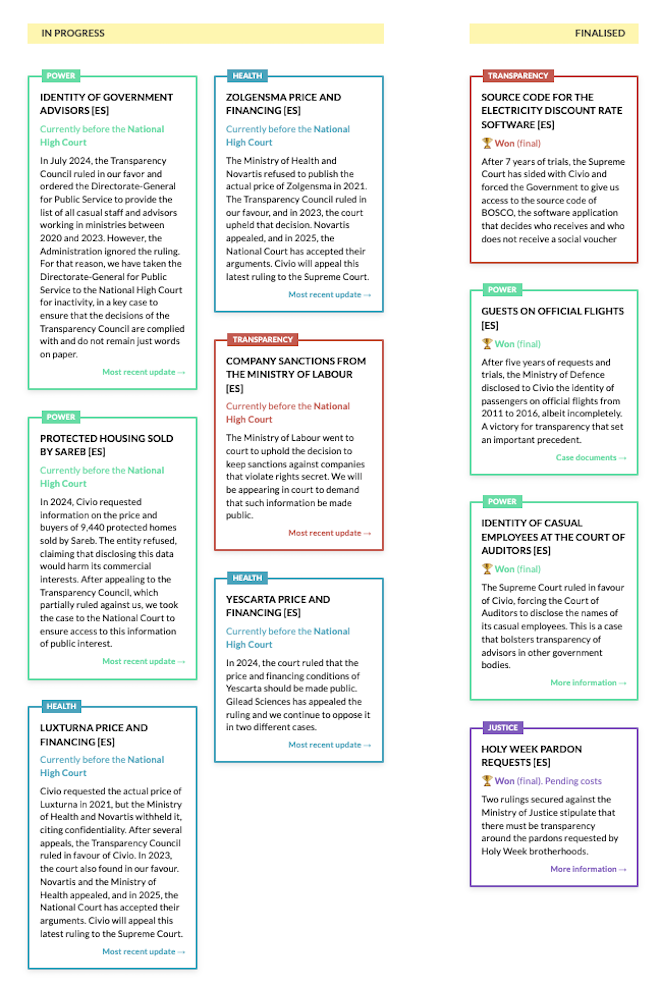
Overview of active and closed cases as of February 2026
🎯 2025 Action Plan — Status
Plan objective. Pursue legal action and open new fronts where relevant information is available, taking matters to the CTBG and courts where necessary, and keeping everyone informed of the process.
Status: Achieved (action and scope).
Evidence. BOSCO was heard by the Supreme Court, where we won and set a precedent; six additional, active court cases.
What's next (2026). Enforcing the BOSCO ruling: ensure the source code and its documentation are actually handed over; and go one step further so that this milestone can be replicated, rather than merely being a legal victory.
Influence: transparency with consequences
Besides investigating and litigating, we worked to ensure transparency and integrity are not reliant on the goodwill of those in power. Every time a plan, law, or agency with a bombastic name pops up, we ask ourselves the same question: will there be any real oversight or is it just a change of narrative?
With the National Anti-Corruption Plan, we highlighted the same old problem: without independence, resources and sanctions, such measures remain on paper. The problem is not only that essential rules are missing: with no real consequences, the measures are nothing more than talk.
When the Fifth Open Government Plan arrived, we were just as clear: we reviewed it and said NO. A lot of talk and not much action where it really mattered.
Regarding the Lobbying Transparency law, we defended a verifiable minimum: a registry is not enough. We need traceability of influence (who meets with whom, about which decisions, with which proposals and documents), independent oversight and a policy of sanctions that acts as a genuine deterrent, without loopholes designed to leave out key players.
The type of influence we’re interested in is not what can be seen in a photo. It’s influence that leaves no trace and evades public scrutiny.
We were just as clear regarding the draft Open Government Bill: if the aim is to cram everything into a single piece of legislation, there is a risk of deadlock and delays. Meanwhile, the concrete, urgent reform of the current Transparency Act lies buried.
With the AI Citizen coalition, we’ve been pushing a simple idea: if an automated system impacts decisions about rights, public money or oversight, it should be trackable and auditable. That’s why we advocate for a useful, mandatory national register of algorithms and automated systems.
🎯 2025 Action Plan — Status
Plan objective. Advocate for change when opportunities for reform arise, hold at least 5 meetings with the authorities to lobby, and participate in consultative and legislative processes.
Status: Achieved.
Evidence. Written contributions in public consultations (Open Administration, Patient Organisations Law, Anti-Corruption Plan, lobbies, Open Government). Meetings with the Ministries of Housing (on data and transparency), Health (for the Medicines Law) and the General Secretariat of National Policy (for the pending agenda on transparency). Work with parliamentary groups on the Lobbying law.
What's next (2026). Continue with the regulatory proposals that are currently underway and on the areas that determine if transparency works: independence, traceability and sanctions. Fewer vague commitments, more binding mechanisms.
Tools and technology: public and user-friendly
At Civio, technology is not “technical”. It’s what makes information user-friendly: tools, databases and systems that allow public sector data to be monitored, tracked and reused without relying on third parties.
That’s where the BOE ‘pills’ come from. For years, much of the BOE work was hosted on third-party sites that changed their rules without warning. In 2025 we brought it in-house, organised it and made it searchable. This isn’t just an “archive”: it’s a public service that never expires.
In España en llamas (Spain in Flames), we finally added complete data for 2017 to the interactive map, and extended the series back to 1983, totalling over 237,000 fires on record. The significance here is twofold: a dynamic tool as well as a critique of the structural delay in disclosing official data, which we have been pointing out for years.
We also launched two new tools in 2025. The Table of Risk Variables (TVR) simulator, which helps users understand the workings of the algorithm employed by Spanish prisons since 1993 to decide on temporary release permits. And the Decretómetro (Decree Meter): the date and outcome of all decree-laws since 1996, by year, by president and—the most substantial part—how many pages they cover and how many rules they change.
Then there’s a less glamorous, albeit crucial task: keeping tools up-to-date. In 2025 we maintained and improved systems that have been in use for years: we updated El Indultómetro (the Pardonometer) with pardons granted in 2025; kept the electricity discount rate and IMV (Minimum Basic Income) tools up-to-date; and expanded the search engine for Temporary Government Staffers with the names we’ve managed to disclose since 2010—complete up to mid-2020, incomplete from then onwards since many ministries refuse to provide basic information on who their advisors are—. All of this, as well as ¿Dónde van mis impuestos? (Where do my taxes go?), Verba, and tracking the price of butane gas bottles: up-to-date data, fixed bugs, a user-friendly experience, links that work. When something proves handy, you’re more likely to use it. That’s the whole idea.
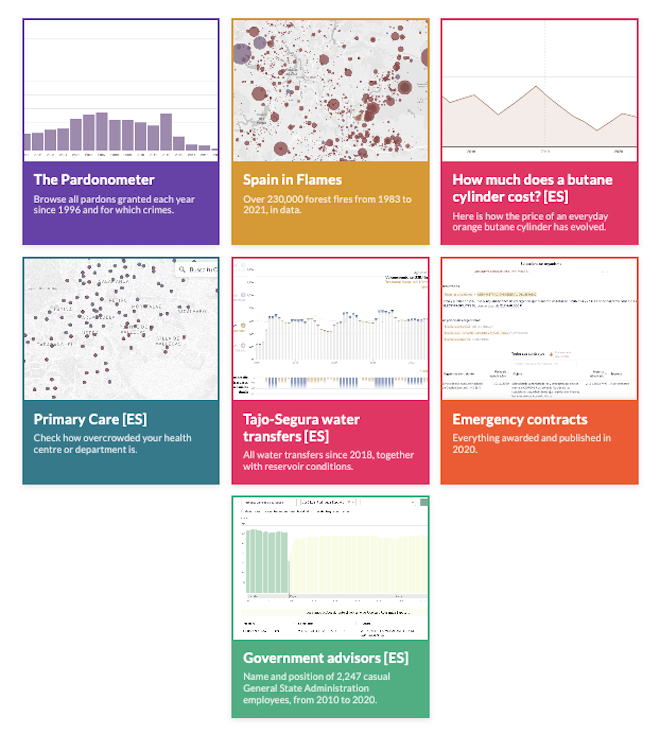
Overview of Civio tools and applications to browse public data
🎯 2025 Action Plan — Status
Plan objective. Improve the website to make it more accessible and user-friendly, maintaining and updating projects and tools.
Status: Achieved.
Evidence. Website improvement completed. Two new tools (TVR simulator and Decretómetro), updating of existing tools and addition of 7 data sets.
What's next (2026). Continue to strengthen internal automation processes that allow us to identify issues sooner and improve internal procedures.
Community and dissemination: from reading to finding each other
In 2025, we reaffirmed a fundamental truth: in journalism, simply turning up isn’t enough. What matters is how you get there, who you reach, and whether you can maintain that connection when a platform changes its rules.
Online, we reached slightly fewer people: as of December, we recorded 1,020,500 unique readers (-9% compared to 2024). Organic traffic—search engines and social media—fell, and this was evident across the board. Conversely, email grew in importance: when the outlook becomes unstable, direct engagement is valued. We closed the year with 25,200 subscribers (+10%), while our free email course on the right of access has attracted about 3,000 people who are learning how to effectively request public information.
Quitting X (formerly Twitter) fits into this context. This was a decision made by the team together with the board of trustees, in consultation with our community, and we are still learning as we go, like many organisations in a fragmented landscape. Maybe the days of social media driving the majority of our traffic are behind us, but it still serves to raise awareness, provide information, and engage with specific audiences. After leaving X, we increased our presence on other channels: LinkedIn +62%, Bluesky +118% and Mastodon +134%. Direct messaging channels also grew (with no aggressive advertising needed): WhatsApp +147% and Telegram +18%.
Dissemination has become more fraught. Others respond by shouting louder. We respond by building bridges and community.
In 2025, we also enjoyed greater external coverage, with over 240 mentions/republications (compared to 210 in 2024). We reinforced our community off-screen too, with 32 training activities (workshops, talks and meetings) and some 1,847 participants, in Madrid, Barcelona, Santander, Elche, Barajas, Castellón and Girona; complemented by 4 online sessions and 7 international engagements (including in Mechelen, Prague and Kuala Lumpur). This “sharing” also involves building expertise and networks: we continue to work with Reference and EDJNet, we’re involved in Dataharvest in Belgium and the GIJC in Malaysia, and we’ve made our work available so that others can continue to follow up on it.
We also held our own gathering: an event on algorithms, transparency and administrations, designed to foster calm debate on a key transparency issue: what it means when public decision-making is automated without providing any explanations. You can watch videos of the meeting here.
🎯 2025 Action Plan — Status
Plan objective. Strengthen our dissemination and community, increase the share of our own channels and, where appropriate, hold an event of our own.
Status: Achieved in terms of our own channels and community; partially achieved in terms of visibility and dissemination.
Evidence. 25,200 newsletter subscribers (+10%); course ~3,000 participants; growth through other social media; 32 training activities and 1,847 attendees; own event. Visibility: 240 mentions (vs target of 300) and a drop in web reach due to the decline in organic traffic.
What's next (2026). Double down on direct engagement and adjust our strategy to no longer depend on an organic "firm foundation" that no longer exists.
Team and internal organisation
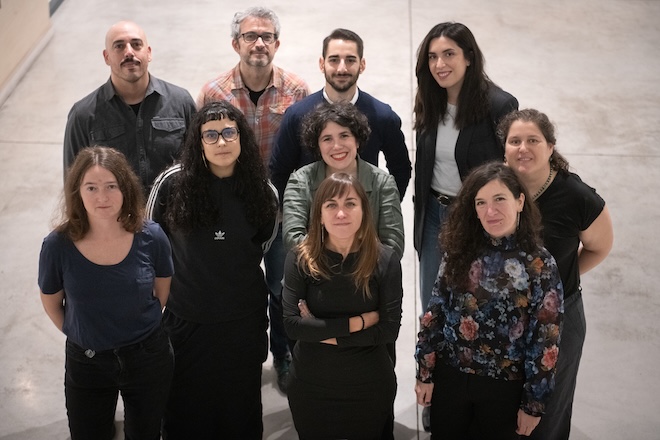
2025 also brought internal changes. The main one was the departure of Ángela Bernando, our deputy director, who left to pursue a career in academia. The fact that it was a career move softened the blow somewhat, but the impact was profound: in a small team, losing someone who contributed so much is felt on a daily basis.
That’s why we decided to internally promote someone who was already working to the same standard and with a similar approach. María Álvarez del Vayo—who joined years ago as an intern—has taken on a greater management role and responsibilities. Meanwhile, we’re still looking to strengthen our team of journalists with an additional member.
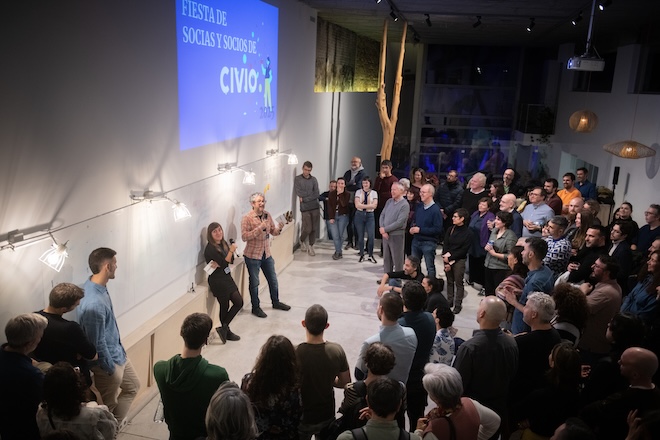
We’re also changing the way we work face-to-face. Olalla requested to work from home in Galicia, so we adapted. We’ve also reinforced the events team with the addition of María Márquez, on a part-time basis. She made her debut at our Algorithms gathering and the end-of-the-year member’s event.
We continue to look after our team’s well-being, allocating a specific budget for physical or mental support. But 2025 also brought strain that shouldn’t be glossed over: once again, there were periods of overload due to excessive administrative work, leaving little time for what adds the most value (planning and research). The priority for 2026 is clear: delegate more, improve coordination, and ensure time is set aside for focussed, in-depth work.
🎯 2025 Action Plan — Status
Plan objective. The 2025 Plan did not include "team" objectives, but did mention capacity-building (research, law suits, products) and promoting in-person engagement.
Status: Achieved, with lessons learnt.
Evidence. Key lines were maintained and the Events team was reinforced, but Ángela's resignation forced a restructuring of responsibilities and increased the burden on management.
What's next (2026). Reduce work overload and set aside time for investigations and programming: more delegating, better planning, and fewer last-minute rushes.
Accounts and sustainability
2025 annual accounts, approved and audited.
2025 closed with finances that can be summed up in one sentence: balanced, with minimum deviation. The final audited accounts show income of €505,863.80 compared to expenditure of €511,396.29, with a deficit of €5,532.49.
A European proposal for which we had high expectations did not go ahead, while we also incurred additional expenses with our first major in-person event (on algorithms, approx. €8,000), which explains part of the shortfall. Even so, the final gap comes to 1.1% of income.
We maintained a diversified funding base to safeguard the organisation’s capacity and independence, and avoid reliance on any single source of funding.
By source: 42% comes from member donations and one-off contributions (€213,881.01); 44% from private grants and support (Civitates, Limelight, European AI Fund and others); 9% from our own services and activities (including the provision of technical and data services, and training); 2% from public funding (through the European EDJNet project); and 3% from other supplementary income.
Strategically speaking, the foundation on which Civio’s future depends the most is support from its community. The €213,881 from small donors account for over four out of every ten euros we spend. The number of regular members rose from 1,982 to 2,297 in 2025 (+16%), exceeding expectations.
Sustainability at Civio also includes accountability. We publish pertinent financial information and documentation here (accounts, audits, management reports and list of supporters). When we demand transparency on the outside, we need to set the standard here.
🎯 2025 Action Plan — Status
Plan objective. Strengthen stability and independence: grow the organisation based on support, diversify funding, and avoid reliance on one single source of funding.
Status: Achieved, with controlled deviation.
Evidence. Our membership numbers have exceeded expectations, the mix of income sources allows us to maintain independence, and the closing deficit is minimal.
What's next (2026). Consolidate growth without losing focus: fine-tune to avoid recurring deficits and ensure sustainability two years ahead.
B-Side: what it took, what we learned, what's next
2025 left three clear friction points. Disclosing them here is not an exercise in humility: it’s part of how we work. If we ask for transparency from others, accountability starts with the things that don’t go well.
-
The actual scope is more difficult to estimate. Organic and social media traffic are no longer a sure thing; what does stand the test of time are the things we control: direct and face-to-face access. We lost 9% of our unique readers. Organic discovery is falling throughout the sector, but that doesn’t exempt us from finding new ways to reach those who need us.
-
Transparency continues to have zero consequences. We saw as much in the resolutions that went ignored, in government departments using “national security” as a cover for their advisors… BOSCO sums it up: a Supreme Court ruling in our favour, yet we still haven’t been given the source code.
-
The internal rhythm. Posting a lot shows off one’s capabilities, but it comes at the expense of innovation and in-depth work.
With that diagnosis in hand, we’re approaching 2026 with specific priorities.
One of these is to enforce the BOSCO ruling: to ensure the code and its documentation are actually handed over, and to pave the way for our legal victory to be replicated whenever an automated system makes decisions on public benefits, rights or services.
Secondly, to bridge the gap between theoretical transparency and compliance: greater traceability, sustained pressure and legal recourse when necessary, because when non-compliance comes cheap, opacity becomes the norm. Like right now.
Thirdly, internal organisation to safeguard time set aside for investigations and programming: fewer time-consuming admin tasks, more delegation, and better planning to avoid last-minute rushes. We need to maintain the standards that ensure a story remains engaging and relevant for years to come.
Meanwhile, in terms of our community, one initiative is already proving to be successful: more in-person meetings, in more towns and cities, to share methods and tools in a relaxed and friendly atmosphere.
If 2025 confirmed anything, it’s this: persistence changes the game. Sometimes it takes a while. Sometimes it takes effort. But the change will come.
Thanks
Nothing you’ve read here happens on its own. It happens because there are people who decide to make it happen: giving their time, attention, guidance, asking uncomfortable questions, and through financial support. Thanks go to our discerning readership, who challenge us to refine our work by demanding evidence, pointing out errors, and discussing nuances. Their high standards help us to improve.
Thank you in particular to our members. Your membership fees are the invisible part of the job: the one that allows us to investigate and persevere when the authorities say “no”, pursuing legal cases such as BOSCO, keeping tools up-to-date, and continuing to ask questions where others have already moved on. You make the difference between posting once and sticking with it until something actually happens.
Thanks also to those of you who make donations—one-offs or recurring—and to the foundations and networks that understand that independence cannot be declared, it must be funded and safeguarded with clear rules. And to the newsrooms, organisations, specialists, lawyers and technologists who share their expertise, helping us to verify information and opening doors for us.
Thanks also to the Board of Trustees, for their sound judgement and support, even when difficult decisions have to be made. In 2025, we were once again able to confirm a basic truth: the public sector is only truly public when someone is keeping an eye on it. We continue to do just that.
✍️ The Civio Team

We are demanding that the Government provide its source code. You've just read ours
What we investigated, what we won, what we failed at. We tell you all about it every year. This is how we earn your trust. Some 2,300 people have already made up their minds, because they know what's at stake. Now you know too.